Erectile Dysfunction • PDE5 Inhibitor

Vardenafil vs Tadalafil Comparison

Vardenafil and Tadalafil are both PDE5 inhibitors, but they differ in onset, duration, and daily‑use potential. Vardenafil is available in tablets, ODT, and soft tabs, while Tadalafil comes in standard tablets and daily formulations. Their mechanism of action is similar, focusing on improved blood flow — learn more in Mechanism. Timing and performance vary, especially regarding food sensitivity and duration; see Onset & Duration and Food Interactions. Safety profiles differ slightly, so review Side Effects before choosing the right option.

Vardenafil vs Tadalafil: Core Pharmacological Overview
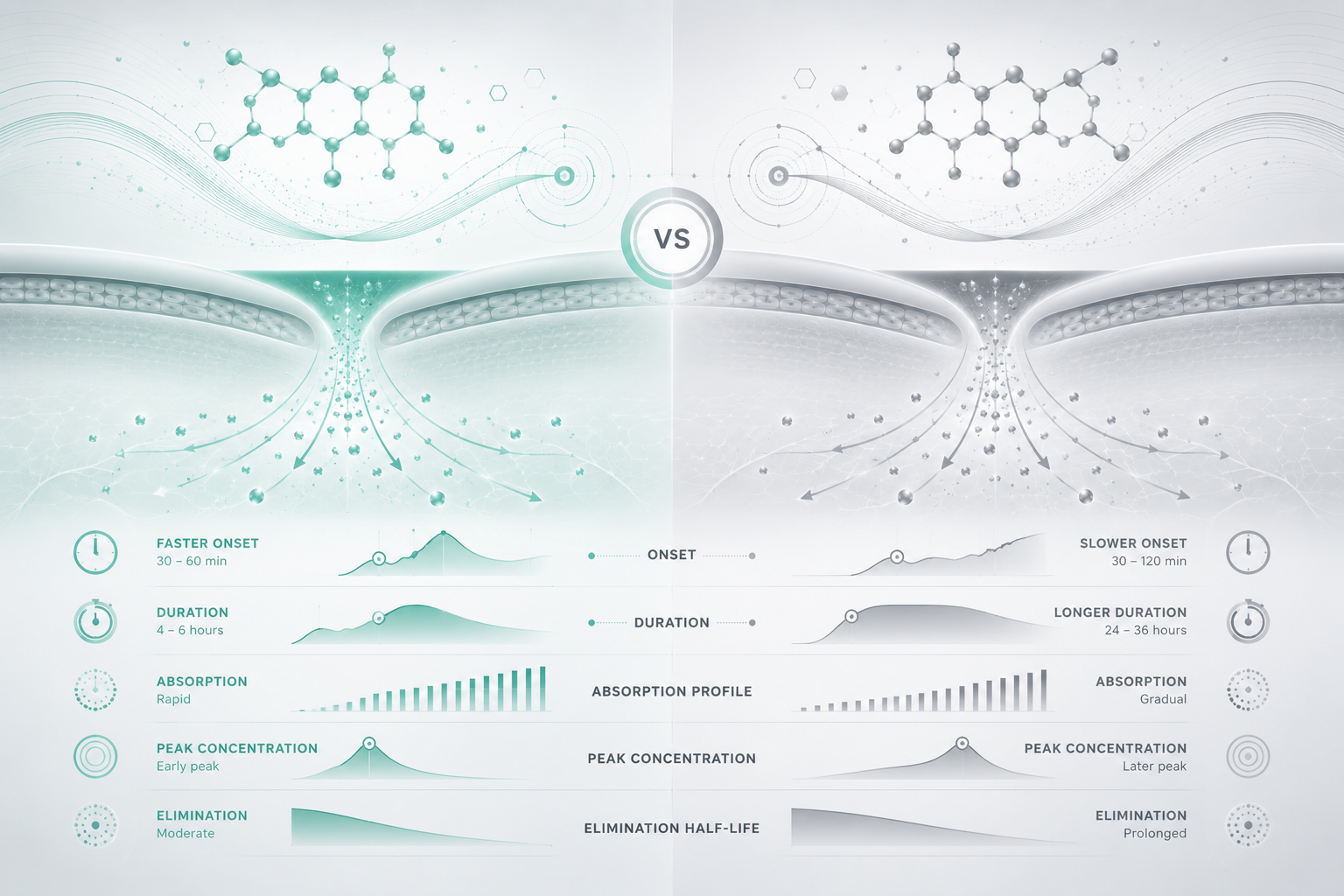
Vardenafil vs Tadalafil

Vardenafil and Tadalafil are both PDE5 inhibitors designed to improve erectile function by enhancing blood‑flow responsiveness during sexual stimulation. Despite sharing the same therapeutic class, they differ in how quickly they act and how long their effects last, making them suitable for different user profiles and dosing strategies.

Vardenafil is known for its stable and predictable onset, offering reliable performance across its available formulations — standard tablets, ODT, and Soft Tabs. These options provide flexibility for men who prefer faster absorption or discreet administration. Its pharmacokinetic profile focuses on consistent onset timing rather than extended duration.

Tadalafil, by contrast, is characterized by its long‑acting nature. Its duration can extend up to 36 hours, making it the preferred option for men seeking prolonged flexibility or those using daily low‑dose regimens. Available primarily as standard tablets and daily formulations, Tadalafil supports both planned and spontaneous sexual activity without frequent re‑dosing.

While both medications operate through PDE5 inhibition, their practical differences — onset stability for Vardenafil and extended duration for Tadalafil — shape how each fits into real‑world treatment preferences and lifestyle needs.

Mechanism Comparison: Vardenafil vs Tadalafil

Vardenafil and Tadalafil share the same core mechanism as PDE5 inhibitors, improving erectile function by enhancing nitric‑oxide–mediated blood flow during sexual stimulation. Their pharmacological profiles, however, differ in selectivity and secondary enzyme interaction, which influences real‑world tolerability and duration. A deeper look at how each works can be found in MOA.

Vardenafil is highly selective for PDE5, meaning it produces strong erectile‑response improvements with minimal off‑target activity. This selectivity contributes to its stable onset profile and lower likelihood of muscle‑related side effects. Its mechanism supports predictable performance across formulations, including tablets, ODT, and soft tabs.

Tadalafil also inhibits PDE5 but has additional affinity for PDE11, an enzyme found in skeletal muscle tissue. This secondary interaction is believed to contribute to occasional muscle aches or lower‑back discomfort reported by some users. At the same time, Tadalafil’s long half‑life and PDE11 interaction contribute to its extended duration, making it suitable for daily use or prolonged flexibility.

Mechanistically, Vardenafil offers higher selectivity and stable onset, while Tadalafil provides extended duration with a broader enzyme profile. These differences shape how each medication performs in timing, tolerability, and dosing strategies.

Parameter Vardenafil Tadalafil
Main target PDE5 PDE5 + PDE11
Half‑life ~4–6 hours ~17.5 hours
Selectivity High Medium

Onset & Duration: How Vardenafil Differs from Tadalafil

Onset and duration are two of the most important real‑world differences between Vardenafil and Tadalafil. Both medications are PDE5 inhibitors, but their timing profiles vary significantly. A detailed breakdown is available in Onset & Duration.

Vardenafil generally acts faster, especially in rapidly absorbed formulations such as ODT and soft tabs. These forms allow quicker plasma uptake, often producing effects within 15–40 minutes depending on the user and formulation. Its duration is moderate, typically lasting 4–6 hours, making it suitable for planned, short‑window use.

Tadalafil has the slowest onset among major PDE5 inhibitors but the longest duration — up to 24–36 hours. This extended “window of opportunity” allows greater flexibility and supports both on‑demand and daily dosing. Tadalafil’s timing is also less affected by food intake, while Vardenafil may experience mild variability depending on meal composition. More details on food impact are available in Food Interactions.

In practice, Vardenafil is preferred for fast, predictable onset, while Tadalafil is chosen for long‑lasting performance and spontaneous flexibility.

Parameter Vardenafil Tadalafil
Onset 15–40 min (form‑dependent) 30–60 min
Duration 4–6 hours 24–36 hours
Food impact Low–medium Low

Effectiveness Comparison: Vardenafil vs Tadalafil

Both Vardenafil and Tadalafil are clinically effective PDE5 inhibitors, improving erectile function across mild, moderate, and severe ED. Their effectiveness profiles differ mainly in timing, duration, and how users respond to various dosing strengths.

Tadalafil is known for its exceptionally long “window of opportunity,” lasting up to 36 hours. This extended duration allows users to maintain flexibility and spontaneity without needing to time the dose precisely. It is also available in daily low‑dose formulations, supporting continuous readiness.

Vardenafil provides a more predictable onset, especially in ODT and soft‑tab forms, making it ideal for men who prefer fast, reliable timing. Its effectiveness is closely tied to dose selection, with common strengths including 5 mg, 10 mg, and 20 mg. These options allow users to adjust performance stability and tolerability.

Overall, Tadalafil excels in duration and flexibility, while Vardenafil stands out for onset consistency and predictable real‑world performance.

Side Effects Comparison: Vardenafil vs Tadalafil

Vardenafil and Tadalafil share a similar core side‑effect profile because both medications act as PDE5 inhibitors, influencing vascular smooth‑muscle relaxation and blood‑flow dynamics. Common reactions such as headache, facial flushing, and nasal congestion occur with both drugs and are well‑documented in clinical studies. A full breakdown of typical reactions is available in Side Effects.

The most notable difference involves muscle and back pain. Tadalafil partially inhibits PDE11, an enzyme found in skeletal muscle tissue. This off‑target interaction may contribute to muscle aches or lower‑back discomfort in some users. These effects are usually mild but occur more frequently with Tadalafil than with other PDE5 inhibitors.

Vardenafil, by contrast, is more selective for PDE5 and has minimal PDE11 activity. As a result, muscle‑related side effects are rare. Its selectivity contributes to a cleaner tolerability profile for users sensitive to musculoskeletal discomfort.

Overall, both medications share common vascular‑related side effects, but Tadalafil carries a higher likelihood of muscle or back pain due to PDE11 interaction, while Vardenafil remains more selective and typically easier on musculoskeletal tolerance.

Side Effect Vardenafil Tadalafil
Headache Common Common
Flushing Common Common
Muscle/back pain Rare Possible
Nasal congestion Common Common

Food & Alcohol Interaction Differences

Food and alcohol interactions influence how consistently Vardenafil and Tadalafil perform, though the degree of impact varies between the two. A detailed breakdown of dietary effects is available in Food Interactions.

Tadalafil is minimally affected by food intake. Whether taken with a light meal or a high‑fat meal, its absorption and onset remain stable. This makes Tadalafil a preferred option for users who want predictable performance without timing doses around meals.

Vardenafil shows moderate sensitivity to food — particularly high‑fat meals — which may slow absorption and delay onset. However, alternative formulations such as ODT and soft tabs bypass much of this variability, offering more consistent timing regardless of meal composition.

Alcohol affects both medications similarly. Moderate drinking may reduce erectile response regardless of PDE5 inhibition, while excessive alcohol can significantly impair sexual performance. Neither drug becomes unsafe with light alcohol consumption, but both may feel less effective when alcohol levels are high.

Daily Use vs On‑Demand Use

Vardenafil and Tadalafil differ significantly in how they fit into daily or on‑demand treatment strategies. Their pharmacokinetic profiles shape how often they can be taken and how long their effects last.

Tadalafil is the only PDE5 inhibitor available in true daily‑use formulations, typically at low doses such as 5 mg or 2.5 mg. Its long half‑life and extended duration — up to 36 hours — allow stable plasma levels that support continuous readiness without timing doses around sexual activity. This makes Tadalafil suitable for men who prefer spontaneity or who engage in sexual activity multiple times per week.

Vardenafil, by contrast, is strictly an on‑demand medication. Its shorter half‑life and moderate duration (4–6 hours) make it ideal for planned use rather than daily administration. Users typically take Vardenafil shortly before sexual activity, benefiting from its predictable onset and flexible formulation options.

In summary, Tadalafil supports both daily and on‑demand strategies thanks to its long duration, while Vardenafil remains a fast‑acting, on‑demand option with stable timing and high selectivity.

Pharmacokinetics & Metabolism (CYP3A4)

Vardenafil and Tadalafil share a core metabolic pathway: both are primarily processed by the CYP3A4 enzyme system in the liver. This pathway determines how quickly each medication is broken down and how long active concentrations remain in the bloodstream. Their pharmacokinetic differences — especially half‑life — directly influence duration and dosing flexibility. More details on dietary interactions can be found in Food Interactions.

Vardenafil has a shorter half‑life (around 4–6 hours), resulting in a moderate duration suitable for on‑demand use. Its plasma levels rise and fall predictably, contributing to stable onset timing across formulations. Tadalafil, by contrast, has a significantly longer half‑life (approximately 17.5 hours), which supports its extended duration of 24–36 hours and enables daily low‑dose regimens.

Grapefruit and grapefruit juice can inhibit CYP3A4, slowing the metabolism of both medications. This may lead to higher plasma concentrations and prolonged exposure. The effect is more noticeable with Tadalafil due to its already long half‑life, potentially increasing the likelihood of side effects. Vardenafil is also affected, but the impact is generally less pronounced because of its shorter duration.

Overall, both drugs rely on CYP3A4 metabolism, but differences in half‑life and exposure shape how long each remains active and how sensitive they are to CYP3A4 inhibitors like grapefruit.

Clinical Use Cases: Timing, Duration & Practical Scenarios

Vardenafil and Tadalafil are both effective PDE5 inhibitors, but their pharmacokinetic profiles make them suitable for different real‑world scenarios. Understanding when each medication aligns with specific timing needs can help clarify their practical roles without offering individualized recommendations. For safety considerations, review Contraindications.

Situations where fast onset is important often align with Vardenafil’s characteristics. Its predictable absorption and rapid action — especially in ODT and soft‑tab formulations — make it suitable for scenarios where timing is planned and users prefer a shorter window of effect. Activities requiring precise timing or minimal delay may benefit from a medication with stable onset.

Scenarios where long duration is valuable align more closely with Tadalafil’s extended half‑life. Its 24–36‑hour activity supports prolonged flexibility, making it suitable for situations where timing is less predictable or where extended readiness is preferred. Daily low‑dose use also fits contexts involving frequent sexual activity or a desire for continuous availability.

Both medications can be used effectively across a wide range of ED severities, but their timing profiles shape how they fit into different lifestyle patterns. Fast onset favors structured timing, while long duration favors flexibility.

Frequently Asked Questions

Tadalafil provides the longest duration among PDE5 inhibitors, typically lasting 24–36 hours due to its extended half‑life. Vardenafil lasts around 4–6 hours, making it more suitable for short, planned windows of activity. Duration differences are tied to each drug’s pharmacokinetic profile and metabolic rate.

Vardenafil generally works faster, especially in ODT and soft‑tab formulations, which can activate within 15–40 minutes. Tadalafil typically requires 30–60 minutes. Onset speed varies by formulation, metabolism, and whether the medication is taken with food.

Tadalafil partially inhibits PDE11, an enzyme found in skeletal muscle tissue. This off‑target interaction may contribute to muscle aches or lower‑back discomfort in some users. These effects are usually mild and temporary but occur more often with Tadalafil than with highly selective PDE5 inhibitors.

Vardenafil is known for its stable and consistent onset, especially in ODT and soft‑tab forms. Its high PDE5 selectivity contributes to predictable timing and fewer muscle‑related effects. Users often find its performance reliable for planned sexual activity within a shorter window.

Yes. Tadalafil is minimally affected by food, maintaining stable absorption even with high‑fat meals. Vardenafil may experience moderate delays when taken with heavy meals, except in ODT and soft‑tab forms, which bypass most food‑related variability. Dietary impact depends on formulation and timing.

Both Vardenafil and Tadalafil are metabolized primarily through the CYP3A4 enzyme pathway. This means substances that inhibit CYP3A4 — such as grapefruit — can increase drug exposure. The effect is more noticeable with Tadalafil due to its longer half‑life and extended duration.

Tadalafil is available in daily low‑dose formulations, typically 2.5 mg or 5 mg, designed to maintain steady plasma levels. This supports continuous readiness and is often used in scenarios involving frequent sexual activity. Daily use is unique to Tadalafil among major PDE5 inhibitors.

Vardenafil’s shorter half‑life — around 4–6 hours — limits how long therapeutic levels remain active in the bloodstream. Its metabolism is faster than Tadalafil’s, resulting in a shorter window of effect. This makes it suitable for planned, on‑demand use rather than extended flexibility.

Not always, but Tadalafil is more likely to cause muscle or back pain due to PDE11 interaction. Many users experience no discomfort, while others report mild, temporary aches. Vardenafil’s higher selectivity means muscle‑related effects are rare, though individual responses vary.