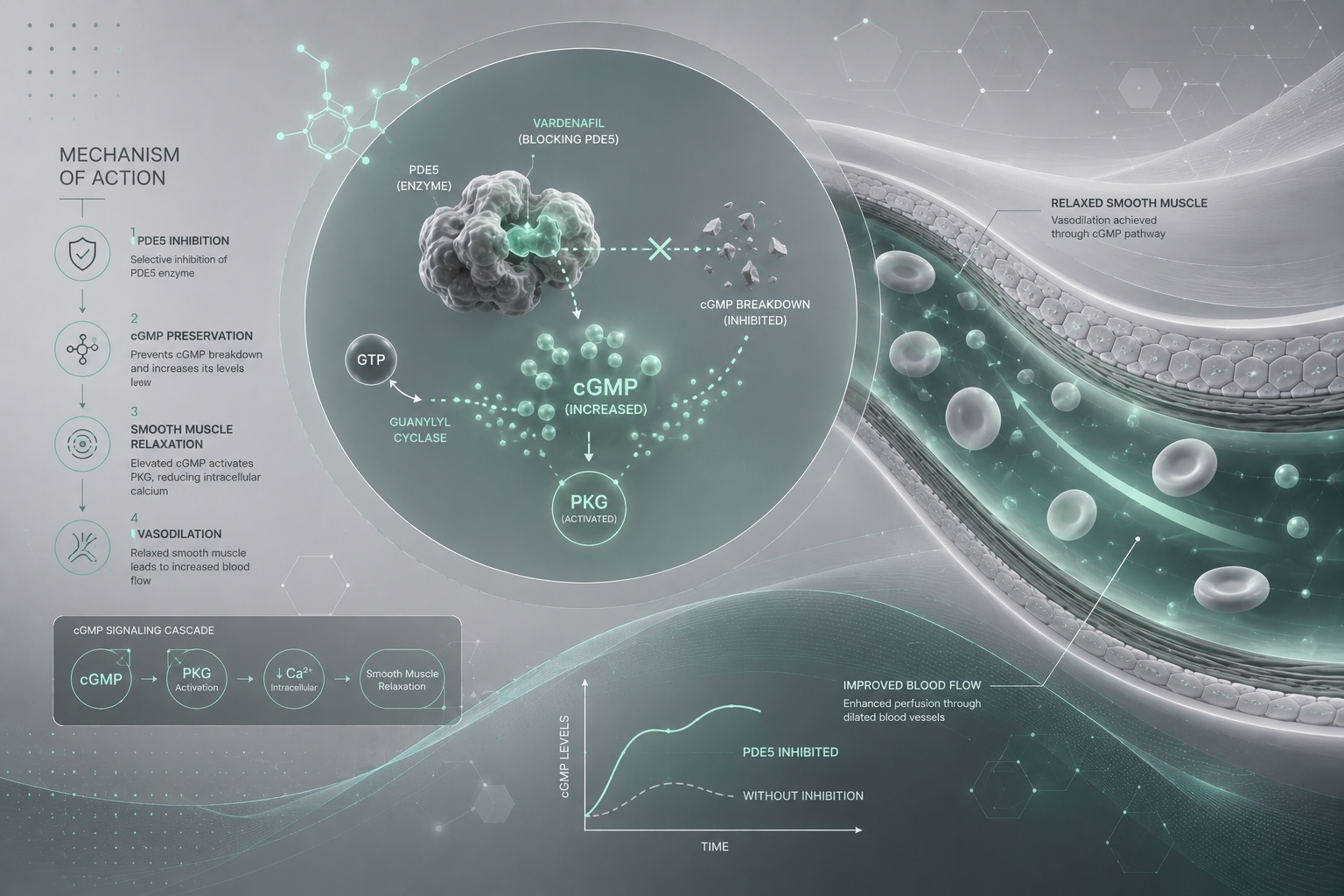
Vardenafil works by selectively inhibiting the PDE5 enzyme, preventing the breakdown of cGMP — the key messenger responsible for smooth‑muscle relaxation in penile vascular tissue. By sustaining cGMP levels, vardenafil supports stronger blood flow responses and delivers a faster, more stable onset compared to shorter‑acting alternatives. Its pharmacodynamic profile is closely linked to nitric‑oxide signaling, ensuring predictable performance under real‑world conditions. Learn more about timing on Onset & Duration, safety considerations on Contraindications, and tolerability insights on Side Effects.
The PDE5 enzyme plays a central role in regulating blood flow within penile vascular tissue. Under normal conditions, PDE5 breaks down cGMP — the molecule responsible for smooth‑muscle relaxation and increased arterial inflow. When PDE5 activity is too high, cGMP levels fall rapidly, preventing adequate vascular expansion and making it difficult to achieve or maintain an erection.
PDE5 inhibition counteracts this process by preserving cGMP, allowing nitric‑oxide signaling to function more effectively. As cGMP remains elevated, smooth‑muscle fibers stay relaxed longer, supporting stronger, more sustained blood flow responses. This mechanism explains why PDE5 inhibitors often demonstrate a predictable onset and stable performance profile, further detailed in Onset & Duration.
Although multiple PDE enzymes exist throughout the body, PDE5 is uniquely concentrated in the corpus cavernosum, making it the primary therapeutic target. Other PDE types — such as PDE1 or PDE11 — have different physiological roles and minimal relevance to erectile function. Safety considerations related to enzyme selectivity and systemic effects are outlined in Warnings.
| PDE Type | Location | Role | Relevance to ED |
|---|---|---|---|
| PDE5 | Corpus cavernosum | Breaks down cGMP | Primary target |
| PDE1 | Brain, heart | Calcium regulation | Minimal |
| PDE11 | Prostate, testes | Unknown | Low |
Nitric oxide (NO) is the primary biochemical trigger that initiates erectile signaling. During sexual stimulation, NO is released from endothelial and neuronal sources, activating guanylate cyclase and driving the production of cGMP — the intracellular messenger responsible for smooth‑muscle relaxation. As cGMP accumulates, the muscle fibers within the corpus cavernosum loosen, allowing blood to fill the erectile tissue and generate a firm erection.
Vardenafil enhances this process by selectively inhibiting PDE5, the enzyme that rapidly degrades cGMP. When PDE5 activity is blocked, cGMP remains elevated for longer, strengthening the relaxation response and supporting more efficient blood flow. This heightened sensitivity to NO signaling is one reason vardenafil often demonstrates a faster and more consistent vascular effect compared to alternatives. Mechanistic differences relative to other PDE5 inhibitors are outlined in Vardenafil vs Sildenafil and Vardenafil vs Tadalafil.
Although sildenafil and tadalafil share the same core pathway, vardenafil’s molecular structure provides stronger PDE5 selectivity and tighter binding affinity. These distinctions influence onset speed, biochemical stability, and overall smooth‑muscle responsiveness — making cGMP regulation a central element of its pharmacodynamic profile.
| Stage | Description | Effect |
|---|---|---|
| NO Release | Triggered by sexual stimulation | Starts cGMP production |
| cGMP Accumulation | Relaxes smooth muscle | Increases blood flow |
| PDE5 Inhibition | Prevents cGMP breakdown | Maintains erection |
Vardenafil is engineered with high PDE5 selectivity, meaning it binds tightly to the PDE5 enzyme while minimizing interaction with other phosphodiesterase subtypes. This selectivity is clinically important: by focusing its action on PDE5 within penile smooth‑muscle tissue, vardenafil reduces the likelihood of off‑target effects that can occur when a drug interacts with enzymes in the eyes, muscles, or other organs. These safety considerations are further detailed in Side Effects and Warnings.
Compared with sildenafil, vardenafil demonstrates lower cross‑reactivity with PDE6 — the retinal enzyme associated with visual disturbances. Tadalafil, while also highly selective for PDE5, shows measurable interaction with PDE11, which may contribute to muscle aches in some users. Vardenafil’s tighter binding affinity and reduced systemic spillover help create a more predictable pharmacodynamic profile with fewer unwanted reactions.
These selectivity differences explain why vardenafil often provides a stable therapeutic effect with minimal systemic symptoms. Its pharmacodynamic behavior reflects a balance of potency, precision, and reduced cross‑enzyme activity — key factors that distinguish it within the PDE5 inhibitor class.
| Drug | PDE5 Selectivity | Cross‑reactivity | Clinical Impact |
|---|---|---|---|
| Vardenafil | High | Low | Stable effect, fewer systemic reactions |
| Sildenafil | Moderate | Medium (PDE6) | Possible visual effects |
| Tadalafil | High | Medium (PDE11) | Muscle aches |
Vardenafil’s rapid onset is driven by its favorable pharmacokinetic profile, including strong bioavailability and efficient absorption through the gastrointestinal tract. Its molecular structure exhibits higher lipophilicity than many alternatives, allowing the drug to penetrate tissues quickly and reach active concentrations in a shorter time frame. These properties contribute to its consistently fast performance, further explored in Onset & Duration.
Absorption speed is also influenced by formulation type. Orally disintegrating tablets (ODT) dissolve directly in the mouth, bypassing part of the digestive process and enabling quicker systemic entry. Soft‑tab formulations provide similar benefits by reducing dissolution time and enhancing mucosal absorption. More details are available in ODT and Soft Tabs.
Compared with sildenafil and tadalafil, vardenafil typically reaches peak plasma levels faster due to its optimized balance of solubility and lipophilicity. This combination allows users to experience reliable erectile response with shorter waiting periods, making vardenafil a preferred option for those seeking rapid, predictable onset.
Vardenafil’s mechanism of action remains the same across all formulations, but the way each form is absorbed significantly affects onset speed and bioavailability. Standard tablets rely on gastrointestinal absorption, which introduces variability based on food intake and digestive rate. This typically results in a 25–40‑minute onset and a predictable but slower rise in plasma concentration. Dose‑specific details are available at 10mg.
Orally disintegrating tablets (ODT) dissolve on the tongue and absorb through the buccal mucosa, bypassing part of first‑pass metabolism. This route accelerates systemic entry, producing a faster onset and higher bioavailability. More information is provided in ODT.
Soft tabs combine buccal and gastrointestinal absorption. Their partial mucosal uptake reduces dissolution time and improves consistency compared with standard tablets, while still offering flexibility in use. Onset typically falls between ODT and tablets, with medium bioavailability. Details are outlined in Soft Tabs.
| Form | Absorption Route | Onset | Bioavailability |
|---|---|---|---|
| Tablets | GI tract | 25–40 min | Standard |
| ODT | Buccal mucosa | 15–25 min | Higher |
| Soft Tabs | Buccal/GI | 20–30 min | Medium |
Vardenafil binds selectively to the PDE5 enzyme, preventing it from breaking down cGMP in penile smooth‑muscle tissue. By sustaining cGMP levels, it enhances nitric‑oxide signaling and supports stronger blood‑flow responses during sexual stimulation. This targeted inhibition is the core of its therapeutic mechanism.
cGMP is the key messenger that relaxes smooth muscle in the corpus cavernosum. When nitric oxide triggers its production, cGMP allows blood vessels to expand and fill erectile tissue. PDE5 breaks down cGMP, so maintaining higher levels is essential for achieving and sustaining an erection.
Vardenafil has higher lipophilicity and more efficient absorption, allowing it to reach active plasma levels faster. Its tighter PDE5 binding also contributes to a quicker functional response. These pharmacokinetic advantages often result in a shorter onset compared with sildenafil.
The core mechanism is identical, but absorption differs. ODT forms dissolve in the mouth and enter through the buccal mucosa, bypassing part of first‑pass metabolism. Tablets rely on GI absorption, which slows onset. These differences affect speed and bioavailability, not the underlying PDE5 inhibition.
Nitric oxide initiates the erection process by activating cGMP production. Vardenafil amplifies this pathway by preventing cGMP breakdown, making NO signaling more effective. The stronger the NO response, the more pronounced the drug’s smooth‑muscle relaxation and blood‑flow enhancement.
High PDE5 selectivity ensures the drug acts primarily on erectile tissue rather than other organs. Reduced interaction with enzymes like PDE6 or PDE11 lowers the risk of visual or muscular side effects. Vardenafil’s strong selectivity contributes to predictable performance and fewer systemic reactions.
The mechanism remains the same across all doses: PDE5 inhibition and cGMP preservation. Higher doses simply increase the magnitude and duration of the response. The biochemical pathway does not change, but the intensity of smooth‑muscle relaxation and blood‑flow enhancement may vary.
Formulations determine how quickly vardenafil enters the bloodstream. ODT and soft tabs dissolve faster and use partial mucosal absorption, reducing delays from digestion. Standard tablets rely on GI processing, which slows onset. These absorption routes directly influence how rapidly the drug becomes active.